TL;DR
Qualifying Instagram leads starts with public profile data and clear evaluation criteria.
- Review Instagram profile signals Check bios, account categories, links, and activity to assess relevance and intent before outreach.
- Use Business Dolphin Radar for structured qualification Apply consistent rules to evaluate Instagram accounts at scale using publicly available data in a compliant workflow.
- Use supporting tools for validation and enrichment Validate high-value leads selectively to improve confidence without replacing qualification logic.
With the right structure, teams can reduce low-intent outreach and focus on Instagram leads that are actually worth contacting.
Why Qualifying Instagram Leads Matters
Instagram can be a useful channel for discovering potential leads, but it should not be treated as a ready-made prospect list. Many profiles lack clear business intent, decision-making authority, or relevance to a specific offer, which makes unfiltered outreach inefficient.
Without a qualification step, teams often see low reply rates, higher deliverability risk, and wasted time. Qualifying leads early helps teams focus on accounts that are more likely to respond and engage.
Data Scope and Usage Boundaries
All qualification methods in this guide rely exclusively on publicly available Instagram profile data — information users have chosen to make visible on Instagram or through linked public pages. This distinction is essential for compliance and sustainable outreach.
Public data includes bio text, account categories, visible links, and publicly displayed contact fields, as well as observable activity signals. Private accounts, DMs, hidden contact details, and any inferred or guessed information are outside the scope of responsible lead qualification.
Lead qualification should serve a legitimate business purpose and comply with Instagram’s platform policies, as well as applicable regulations such as GDPR and CAN-SPAM. Tools like DolphinRadar Business operate within these boundaries by correlating public signals only and avoiding access to private or restricted data.
Not every Instagram account will display a public email. That limitation is expected and should be accounted for in any compliant workflow.
Method 1: Manual Instagram Lead Qualification
Profile-first, signal-based evaluation
How it works
Manual qualification focuses on reviewing Instagram profiles to assess whether an account represents a relevant and reachable business lead. This process starts with evaluating public profile signals, such as bio descriptions, account category, visible links, and posting behavior.
Rather than looking for contact details immediately, the goal is to understand intent and relevance. Profiles that clearly describe a role, niche, or offering — and show consistent activity — are more likely to represent meaningful outreach opportunities.
Pros
- No tools required
- Flexible, human judgment
- Useful for early exploration
Cons
- Subjective and inconsistent
- Time-consuming as volume grows
- Difficult to standardize across teams
Best for
Early-stage research, founders validating a niche, or small lead sets where context matters more than scale.
Method 2: Structured Lead Qualification with DolphinRadar Business
From profile relevance to contactability
How it works
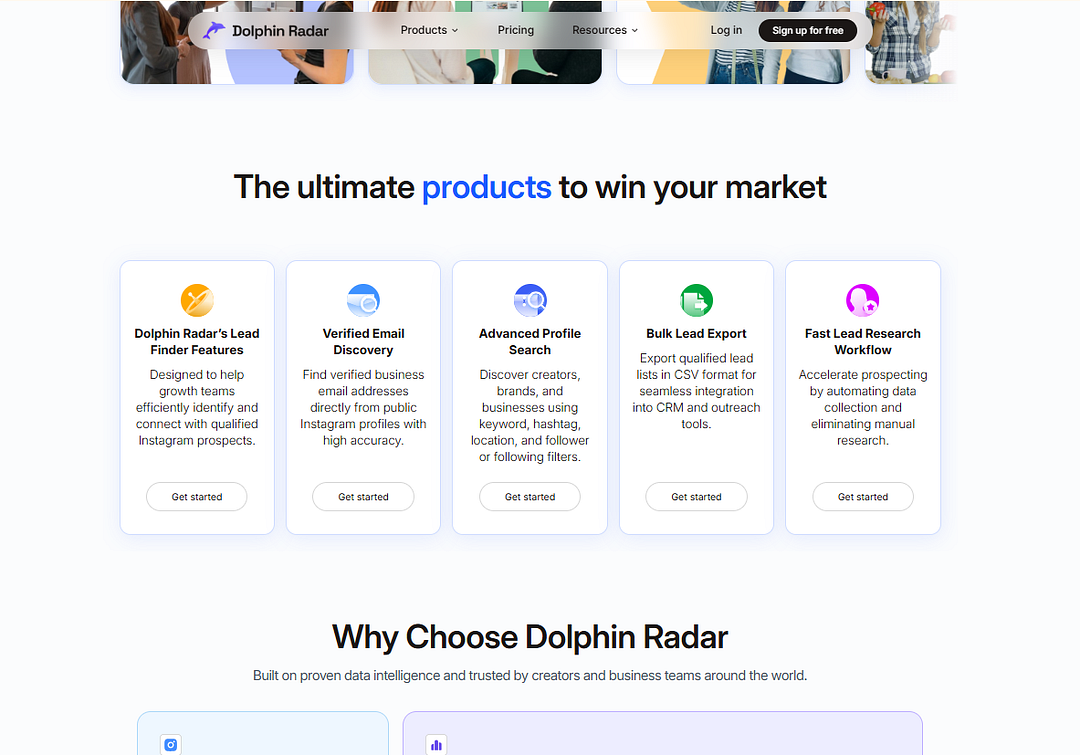
As lead volume increases, teams need a structured way to qualify Instagram accounts using consistent criteria. DolphinRadar Business supports this by organizing public Instagram profile data into a repeatable workflow that helps teams move from relevance assessment to contact readiness.
Instead of manually reviewing profiles, teams can evaluate accounts based on standardized signals such as bio intent, account category, website presence, and profile completeness. Within this qualified set, DolphinRadar Business helps identify which accounts have publicly available business contact information, including email addresses shared via profiles, Contact buttons, or linked public pages.
This approach ensures that email discovery is applied after qualification, not before, keeping the workflow aligned with compliance and relevance requirements.
Pros
- Structured, repeatable qualification logic
- Designed for Instagram-first workflows
- Connects lead quality with contact readiness
- Uses publicly available data only
Cons
- Limited to information users choose to make public
- Not intended for private data access
Best for
Sales teams, agencies, and growth teams that need to qualify Instagram leads at scale and identify which accounts are suitable for email outreach.
Method 3: Research and Validation Using External Platforms and Tools
Supporting signals beyond Instagram
How it works
After Instagram leads have been qualified based on public profile data, external platforms and tools can be used to validate assumptions and add context, especially for higher-value accounts.
This layer does not drive lead discovery on its own. Instead, it helps confirm whether a qualified Instagram account represents a real business entity, decision-maker, or contactable organization using public information available outside Instagram.
Common platforms and tools
Professional and social platforms Platforms such as LinkedIn, X (Twitter), and YouTube are often used to cross-check identity and intent. Many professionals share clearer role descriptions, company affiliations, or contact preferences on these platforms than on Instagram alone.
Company websites and public pages Official websites, About pages, and Contact pages remain one of the most reliable sources of publicly disclosed business information. When an Instagram profile links to a domain, reviewing these pages helps validate legitimacy and relevance.
Domain-based email tools Tools like Hunter.io, Clearbit, or similar domain-based services can support validation when a company website is known. These tools help surface publicly indexed email addresses or common email patterns, but they are not Instagram-native and should not be used to infer private contact details.
AI-assisted research tools AI tools such as ChatGPT can assist with summarizing public context, suggesting likely email formats, or identifying where contact information may be published. AI outputs should always be reviewed and confirmed against publicly available sources.
Pros
- Adds confidence for high-value or strategic leads
- Helps validate business identity and context
- Useful for cross-platform consistency checks
Cons
- Not designed for Instagram-first qualification
- Fragmented workflows across multiple tools
- Limited value without prior lead qualification
Best for
Selective validation and context-building after an Instagram lead has already been qualified, particularly in account-based or higher-stakes outreach workflows.
Compliance and Ethical Use
Even when working with public data, responsible use matters. Teams should avoid private accounts, respect opt-out requests, and clearly identify themselves during outreach.
In B2B contexts, compliant and ethical use of data protects both deliverability and brand trust. Qualification is most effective when relevance and transparency are treated as core requirements.
Key takeaways
Qualifying Instagram leads is most effective when treated as a structured evaluation process, not a one-off judgment. Public profile data — such as bio intent, account category, visible links, and activity signals — provides enough context to determine whether an account is relevant and ready for outreach before any contact is made.
As volume increases, consistent results come from workflows that combine manual review, Instagram-first qualification, and selective validation. Tools like Business Dolphin Radar help centralize this process by working exclusively with publicly available data and aligning lead qualification with platform policies and applicable data protection requirements, supporting sustainable and professional outreach at scale.
FAQ
What public Instagram data can be used for lead qualification?
Bio text, account category, visible links, public contact fields, and observable activity signals.
Is qualifying Instagram leads using public data allowed?
In most B2B scenarios, yes — when based on public information and used responsibly.
Are private Instagram accounts suitable leads?
Private accounts lack sufficient signals and are generally not suitable for qualification.
How is lead qualification different from finding emails?
Qualification determines whether a lead is worth contacting. Email finding focuses on how to reach them.
Does DolphinRadar Business access private Instagram data?
No. It only works with information that is publicly available on profiles.
Who benefits most from this approach?
Sales teams, agencies, growth teams, and B2B teams running outbound workflows.
Author: Business Dolphin Team
Last updated: January 2026